- that is a difficult question! (With, again, apologies to Ol' Bill Shakespeare.)
The reason the question is difficult is because our weather here in northern Indiana continues to be, as I put it previously, weird! We've continued to see unusual swings in temperature, from shirtsleeve weather to well below freezing and back to balmy, all in a matter of a few days! Before the middle of March had arrived, one of my yews had already started to set this year's crop of arils. Here, that's about a month early!
All else being equal, I would love the chance to start repotting a month early and gain that much on the growing season! But what makes the question difficult is that this year, all is not equal. We have the early warmup, but we also continue to have the wild swings in temperature. Together they create the dilemma.
For any who may not be familiar with the nature of the dilemma - and especially readers in tropical parts of the world - here it is.
When temperate-zone plants emerge from their winter dormancy, growth goes into high gear, both above and below ground. New leaves emerge, twigs elongate, new wood is laid down; and the roots, at the same time, are spreading out, developing new feeder roots, adding girth to primary roots, and so on. This rapid growth continues for roughly six weeks (exact length of the growth flush varies by species,) and then tapers off. Growth continues slowly for the rest of the season, but most of the plant's resources after the first six to eight weeks are directed toward maturation of tissues and then into storage of sugars for the following spring's growth flush. (Some species have a second, some even a third, growth flush later in the season; but the spring growth push is always the biggest and most important.)
Obviously, the ideal time to repot one's trees is right at the start of the spring growth flush (signaled by the swelling of the leaf and needle buds.) At that point, the roots are starting rapid growth, and the tree will recover from root-pruning most quickly and with the least trauma.
Unseasonable cold throws a wild card into the game. New roots are sensitive to cold, newly pruned roots even more so. Cold slows down root growth, and thereby slows down recovery for a freshly repotted tree. Worse, too much cold, or cold that's too severe, can injure or even kill new root tissues.
The other horn of the dilemma is the fact that the repotting window is limited. Miss the window, and the tree's root system will struggle to recover. If the tree is a conifer, and especially if it's a member of the Pinaceae, if the window is missed the root system usually won't recover at all. This is a lesson I have personally learned the hard way; I've killed more pines by wrongly-timed repotting than by another mistake.
And this year's window has opened early. Bonsai practitioners who wait too long for temperatures to stop imitating a roller coaster risk missing the repotting window altogether. Waiting another year is then often the safest option, but has its downside: a tree that is not repotted when it needs it will start to become rootbound (or more rootbound,) and will miss out on the overall rejuvenating effect of root pruning.
On the other hand, bonsai growers who proceed with repotting now risk having their trees' roots injured by a siege of atypically cold temperatures, and the trees' progress set back as a result. If root pruning has been extensive, a tree could even be killed by a sufficiently deep cold snap.
After weighing the risks on both sides, I've decided to go ahead and repot those trees that are due for it, as fast as I can make the time. (Making time is complicated by the fact that my family and I are moving into a new house, which is also a reason I haven't posted anything on this blog for a few months.)
I'm taking a few extra precautions.
Here are pictures of two of the trees I've worked on so far.
This 'Densiformis' yew is the tree I won in a raffle at the MABA 2015 convention last year. (See the end of this post.) On April 16 I plan to take it to a Styling and Refinement workshop with Vance Hanna of the Four Seasons Bonsai Club of greater Detroit, so I didn't do a full repotting of this tree. I shifted just enough soil to let me correct the planting angle, did no root-pruning, and have been babying it ever since!
I've become a bit fascinated recently with the bunjin style (a.k.a. literati.) I bought this Korean hornbeam from Meehan's Miniatures last August with an eventual bunjin in mind.
For all my friends in the temperate zones of the Northern hemisphere: best wishes with your repotting, whenever you're able to do it!
The reason the question is difficult is because our weather here in northern Indiana continues to be, as I put it previously, weird! We've continued to see unusual swings in temperature, from shirtsleeve weather to well below freezing and back to balmy, all in a matter of a few days! Before the middle of March had arrived, one of my yews had already started to set this year's crop of arils. Here, that's about a month early!
All else being equal, I would love the chance to start repotting a month early and gain that much on the growing season! But what makes the question difficult is that this year, all is not equal. We have the early warmup, but we also continue to have the wild swings in temperature. Together they create the dilemma.
For any who may not be familiar with the nature of the dilemma - and especially readers in tropical parts of the world - here it is.
When temperate-zone plants emerge from their winter dormancy, growth goes into high gear, both above and below ground. New leaves emerge, twigs elongate, new wood is laid down; and the roots, at the same time, are spreading out, developing new feeder roots, adding girth to primary roots, and so on. This rapid growth continues for roughly six weeks (exact length of the growth flush varies by species,) and then tapers off. Growth continues slowly for the rest of the season, but most of the plant's resources after the first six to eight weeks are directed toward maturation of tissues and then into storage of sugars for the following spring's growth flush. (Some species have a second, some even a third, growth flush later in the season; but the spring growth push is always the biggest and most important.)
Obviously, the ideal time to repot one's trees is right at the start of the spring growth flush (signaled by the swelling of the leaf and needle buds.) At that point, the roots are starting rapid growth, and the tree will recover from root-pruning most quickly and with the least trauma.
Unseasonable cold throws a wild card into the game. New roots are sensitive to cold, newly pruned roots even more so. Cold slows down root growth, and thereby slows down recovery for a freshly repotted tree. Worse, too much cold, or cold that's too severe, can injure or even kill new root tissues.
The other horn of the dilemma is the fact that the repotting window is limited. Miss the window, and the tree's root system will struggle to recover. If the tree is a conifer, and especially if it's a member of the Pinaceae, if the window is missed the root system usually won't recover at all. This is a lesson I have personally learned the hard way; I've killed more pines by wrongly-timed repotting than by another mistake.
And this year's window has opened early. Bonsai practitioners who wait too long for temperatures to stop imitating a roller coaster risk missing the repotting window altogether. Waiting another year is then often the safest option, but has its downside: a tree that is not repotted when it needs it will start to become rootbound (or more rootbound,) and will miss out on the overall rejuvenating effect of root pruning.
On the other hand, bonsai growers who proceed with repotting now risk having their trees' roots injured by a siege of atypically cold temperatures, and the trees' progress set back as a result. If root pruning has been extensive, a tree could even be killed by a sufficiently deep cold snap.
After weighing the risks on both sides, I've decided to go ahead and repot those trees that are due for it, as fast as I can make the time. (Making time is complicated by the fact that my family and I are moving into a new house, which is also a reason I haven't posted anything on this blog for a few months.)
I'm taking a few extra precautions.
- First, I'm keeping root disturbance to a minimum, even on species like trident maple that normally shrug off massive root-pruning. That means less root rejuvenation, but it also means that when temperature plunges occur, the root system has not been temporarily weakened by pruning any more than is absolutely necessary.
- Second, in a cold spell it's even more important to protect newly-repotted trees from the drying effect of wind. Newly pruned roots can't take up as much water to re-hydrate the leaves and twigs in the first place, and that's more true when they're cold. Extra demand for water because of desiccation of the tree above ground is the last thing they need!
- Third, I've been doing "The Shuffle" as needed. Saturday afternoon I made sure the repotted trees were in the mudroom in anticipation of that nite's expected low of 24 Fahrenheit (almost -5 Celsius.) The next day after church I took them back outside to enjoy a day or two of milder weather. Tonite those trees are back in the mudroom for a few days. I expect to keep up the in-and-out for several more weeks, at least.
Here are pictures of two of the trees I've worked on so far.
This 'Densiformis' yew is the tree I won in a raffle at the MABA 2015 convention last year. (See the end of this post.) On April 16 I plan to take it to a Styling and Refinement workshop with Vance Hanna of the Four Seasons Bonsai Club of greater Detroit, so I didn't do a full repotting of this tree. I shifted just enough soil to let me correct the planting angle, did no root-pruning, and have been babying it ever since!
 |
| Taxus x media 'Densiformis,' after work was finished March 13. Provisional front. |
 |
| Foliage buds about to burst. April 5, 2016. |
I've become a bit fascinated recently with the bunjin style (a.k.a. literati.) I bought this Korean hornbeam from Meehan's Miniatures last August with an eventual bunjin in mind.
 |
| Carpinus coreana before repotting; March 11, 2016. |
 |
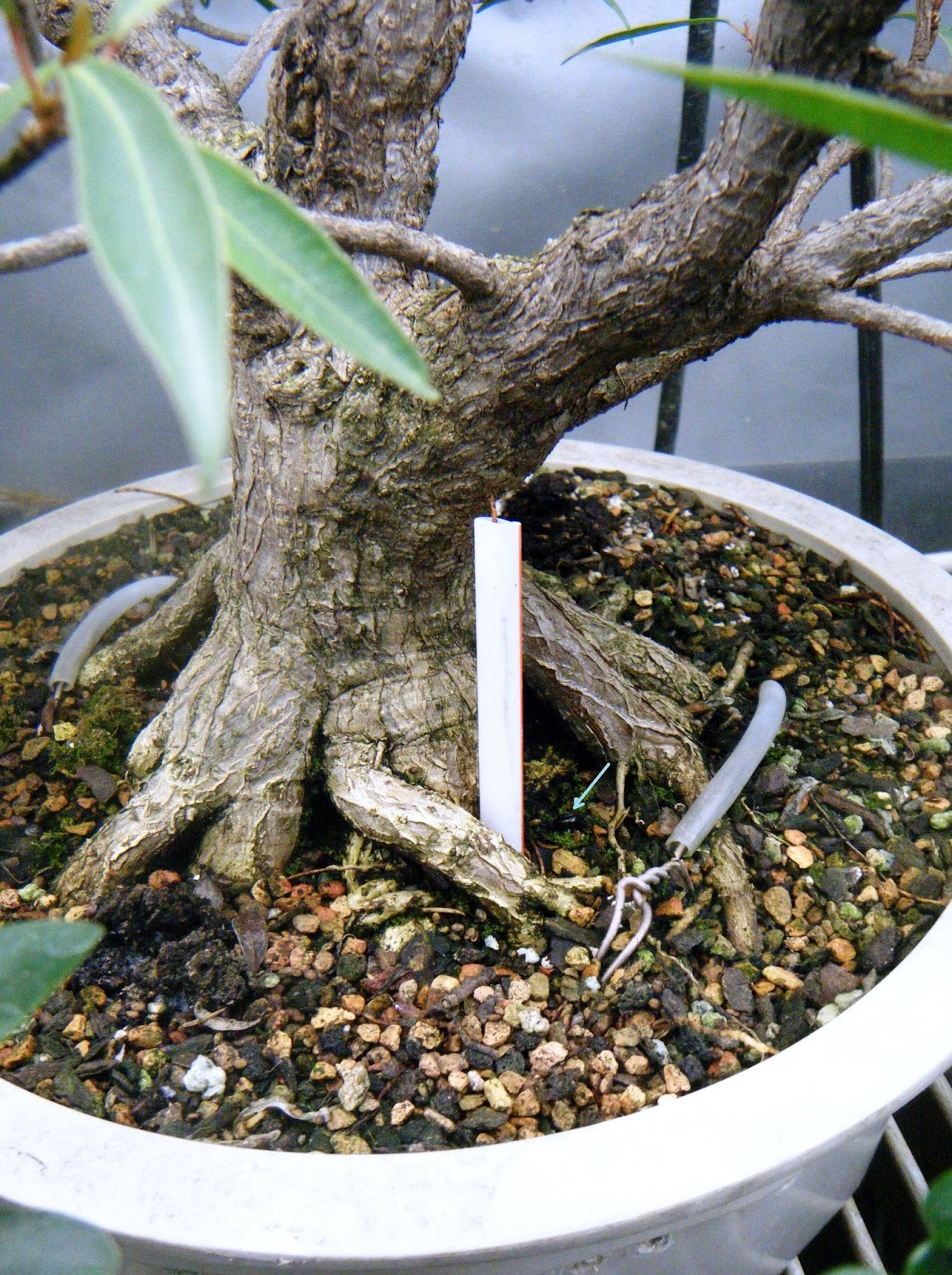
| Repotted and with new front selected. The wound indicated by the arrow will become a small uro. Picture taken April 5, 2016. |
 |
| New leaves emerging on Carpinus coreana. April 5, 2016. |
:-) :-) :-)