Welcome to my bonsai blog!


Welcome to my bonsai blog!

Look around! Use the Search box, browse the Archive, and leave comments. Click on any picture to enlarge it.
I would be honored to have you follow my posts. There are two ways to do that.
-- If you have your own blog, use Join this site
to have notifications of my posts sent to your blog's reading list.
-- If you don't have a blog,
use Follow by Email: new-post alerts will be sent to your email address. Pictures aren't included; that's just how Blogger does it. For the pictures you come here!
Fora and vendors that I can recommend from experience are listed in the right sidebar.
For more about the ads, and just why I enabled them, please see "About the ads," below.
"And the LORD God made ... trees that were pleasing to the eye ..." Gen. 2:9, New International Version.

"Bonsai isn't just something I do; it's part of what I am." Remark to my wife and daughter.

Tuesday, April 7, 2020

Learning More About Akadama

Hard akadama, maximum particle size about 5 mm.
          Since my first blog post about akadama two years ago, I think I can safely say that my understanding of the subject has become a little more nuanced. In particular, I've learned more about akadama use in a climate like mine: temperate, freezing temperatures in winter, 40 inches of precipitation in an average year. (And in spring, a tendency to go from shirtsleeves to sleet within 24 hours!)

In my last post I mentioned that Andrea Wigert and Adam Lavigne, both in Florida, told me that they don't use akadama in their respective planting mixes because it stays too wet in their rainy climate. I decided to seek the input of a bonsai professional in a climate a lot more like mine. So I contacted a man from whom I've already learned a lot, Mark Fields, of Bonsai by Fields LLC in Indianapolis.

I particularly wondered if Mark uses akadama in his planting mix for ponderosa pine (Pinus ponderosa). I have a yamadori ponderosa from Golden Arrow Bonsai that is due for repotting this spring. Ryan Neil, of Bonsai Mirai, recommends akadama very highly, and I had the components to duplicate his ponderosa mix, a 1:1:1 blend of akadama, pumice and scoria. But first, I wanted to get the thoughts of an experienced grower closer to home. A big "Thank you!" to Mark for discussing the question with me in a series of emails. ðŸ˜„

Here is what Mark told me.
  • First, he uses akadama or an akadama blend for everything except ponderosa pines and California junipers. For those species, he substitutes a product called calidama. As I understand it, calidama is a fired-clay product which absorbs water very slowly and releases it very slowly.
  • Mark allows his temperate-zone trees to freeze over the winter, in a cold greenhouse. It's been his experience that akadama goes into winter still holding enough water that, once it freezes, the particles at the surface, exposed to the air, disintegrate into dust by spring. He didn't say so, but I presume that with a dryland species like ponderosa, Mark doesn't want to take a chance on that dust building up over time and clogging the pores of the soil. With other species, he simply tilts the pots up in the spring and brushes off the dust.
  • Akadama particles below the surface, in Mark's observation, retain their structural integrity.

My climate, here in what many call "Michiana", is both a little colder and a little drier than Mark's in Indianapolis. But after reading of the freezing-and-crumbling, I had almost concluded that I had best not use Ryan Neil's ponderosa mix, which is one-third akadama, but devise something myself.

Then I got an unexpected chance to ask Ryan directly whether he has ever had the problem Mark described: that of akadama on the surface freezing and crumbling. (His location does get freezing temperatures in winter.) He answered that he hasn't, and attributes that fact to the use of a top dressing of shredded sphagnum, which acts as a bit of a blanket over the surface particles.
July 24, 2019, after first styling ; provisional front.

So - with great respect for Mark Fields, and great appreciation for his helpfulness and input - I have decided to use Ryan's recipe, that 1:1:1 mix of akadama, scoria and pumice. I admit I made the decision with some trepidation! And if the tree should suffer as a result, the responsibility is of course mine alone.

Repotting is set for tomorrow morning, once the anticipated rain clears out. The tree is ready, the mix is ready, the pot is ready, and I'm ready. I'll let you all know how it goes in a future post. Here's the tree, after first styling in a workshop with Andy Smith last summer.

(To see my earlier post about akadama, click here.)

:-)  :-)  :-)

Saturday, February 8, 2020

A Visit to Wigert's Bonsai

     One of our older girls and her husband, Kira and Trent, flew my wife Princene, our youngest NaevEnya, and me to south Florida for a few days as a Christmas gift. While there, we were able to visit Wigert's Bonsai, about a 30-minute drive away. I'd already gotten one tree from Wigert's online store. Now I was able to see the place in person!

Wigert's Bonsai raises and sells tropical species for bonsai, as well as some trees that aren't strictly tropical but still grow well in their area. They offer a tremendous selection: I saw well over a dozen species and varieties of Ficus, as well as Fukien tea, Florida buttonwood, sea grape, bougainvillea (with half-a-dozen different bract colors), tamarind, gumbo-limbo (Bursera), podocarpus, bald cypress, Chinese elm, Brazilian raintree, parrot's-beak, sageretia, Premna (popular in southeast Asia), Barbados cherry, and, and, and - you get the idea. I even saw Ceiba, or kapok, which I knew from my boyhood in Ecuador, each trunk covered in stout pyramidal thorns.

Their display of prebonsai and partially-shaped stock probably covers more than 2 acres. Here are a few pictures:

Partly-shaped bonsai-to-be beside a Casuarina tree near their store.

Florida buttonwood (Conocarpus erectus), some of them collected.
I joked to the family that they could leave me here and come back in 2-3 days!
Erik and Andrea Wigert own and operate the nursery together, and have their own collection of bonsai. Some of their trees are simply stunning. Here are some more pictures. A few of their own trees are kept by their koi pond ...

This buttonwood (which I presume is a yamadori) is one of their finest bonsai.
You can see my wife in the background, holding her own camera.
Each trunk of this bougainvillea clump is as thick as a man's thigh.
The pot is - literally - the size of a small bathtub. 
.. and the rest of their own trees are in a gravelled area near their house.
I told NaevEnya that this Ficus salicaria was the tree I "would be most tempted to steal!" <wink>
(Forgive the "photobomb" by the power pole in the background.)
Princene, NaevEnya and me beside that Ficus salicaria (willow-leaf fig).
A collected buttonwood. You can see how well the species works for jin and shari.
I got the impression that Erik is the grower, the "behind the scenes" partner, while Andrea handles the store and is usually the one to talk to visitors. I asked her whether they use akadama in their planting mix, and she immediately answered "No." In their rainy climate, she told me, it simply stays too wet. That matches what I've been told by Adam Lavigne, who practices and teaches bonsai not that far away in central Florida. (He in fact refers to it as "aquadama.") Andrea showed me their mix: a coarse blend of scoria, composted bark, and what she called an "expanded clay product," which she said holds no water. It felt to me like a lightweight pebble.

Our son-in-law Trent, chauffeur to us all, is also interested in bonsai and was ready to get his first tools. Wigert's store prices are quite reasonable, and I recommended a few items to start with, such as concave cutters. The Wigerts also offer a schedule of classes, which he hopes to take advantage of.

Ever since I read some things that Jerry Meislik had to say about Ficus rubiginosa, the Port Jackson or rusty fig, I've been interested in getting one. But I wanted to see one "in person" first, before I took it on. When I mentioned my interest in Port Jackson fig, the family members with me offered to help search the display area for specimens. I gave them the scientific and common names again. Then, as we were all about to scatter over more than two acres packed with prebonsai trees, I happened to glance down at the sign identifying the trees beside - right beside - which I was standing. You guessed it - "Port Jackson fig!"

Trent and Kira kindly bought me a Port Jackson fig as another Christmas present, and the airline and TSA kindly let me bring it home on the plane. Here's a picture taken after I got it home.
My Ficus rubiginosa; you can see why one of the common names is "rusty fig".
The pot is 8 inches across (about 20½ cm); base of the main trunk just over an inch in diameter.
Thanks for everything, Trent and Kira!

For a link to Wigert's website, see the sidebar. 

(For any regular readers who have wondered at my 6-month silence on this blog, various health issues, mainly related to the passing of time, have been largely responsible. I hope to resume writing often enough for it to be worth your while to read - assuming you consider it worth your while in the first place!)


:-)  :-)  :-)


Saturday, August 31, 2019

Amphibians!

     Ecological scientists tell us that amphibians, such as frogs, toads and salamanders, are much like the proverbial canary in the coal mine: they give early warning. If there is an ecological problem, those creatures are affected  before almost any other animals. If they start disappearing, you know something is wrong in the local ecology. Conversely, a healthy population of amphibians in a given area means the local ecology is healthy, too.

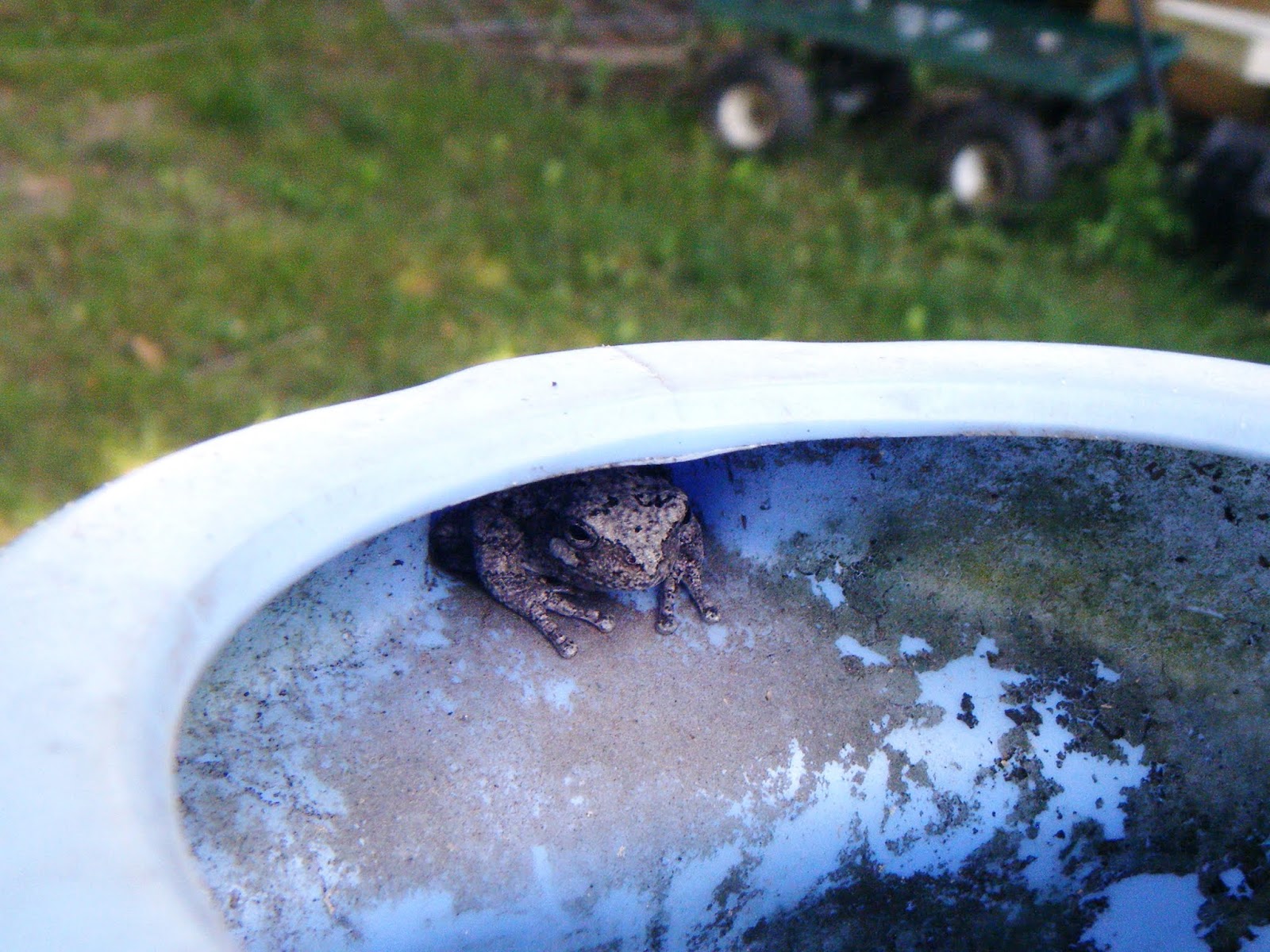
So I am pleased to see the number of frogs, mainly tree frogs, that we have around Dandelion Acres (my wife's provisional name for our homestead). A few weeks ago I discovered that one had decided that the hollow handle of my plastic watering can would be a good hiding spot as he (she?) lay in wait for insects.

Its natural camouflage does blend in a little with the algae spots in my watering can.
Then the critter detected my presence.

Braced to skedaddle.
I encouraged it to find another ambush spot with a few taps on the side of the can, and it took off.

Then this afternoon I noticed another frog trying to blend in on the bark of a ponderosa pine in development.

Its color does blend in with the green of the needles a bit, but the brown of the bark is another matter.
We also see them hopping across the parking apron, evading our dogs and the neighbors' cats, and moving thru the grass. Earlier in the season they gave a nightly concert from our above-ground pool. (Which the local green herons seemed to regard as their own smorgasbord.)

Wherever they are, I always like to see that our ecological "coal mine" has healthy "canaries".

:-)  :-)  :-)

Tuesday, June 4, 2019

"Thanks! I wanted that!"

     One year when I was away at university, my father sent me a birthday check with a note instructing me to use the money for something I really wanted, but couldn't quite afford to buy. I don't remember now what I used the money for, but what my dad said in his note has stuck with me. Any more, ask me what I want for Christmas or a birthday and I'll apply Dad's criteria.

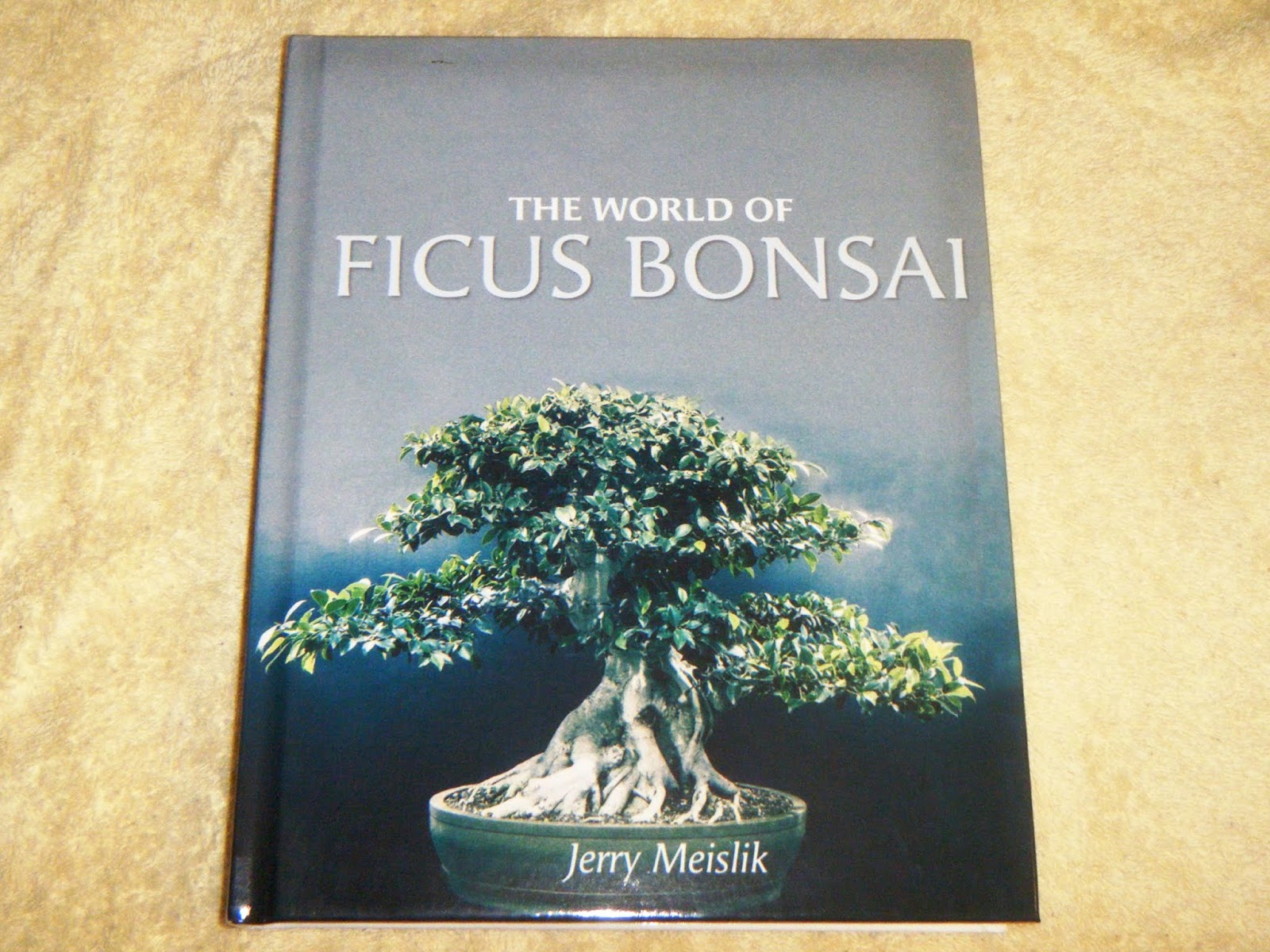
So when my wife and daughter asked me what I would like for my latest birthday, I stopped to consider: what was something I would like to have and would definitely use, but for which I hadn't yet felt free to spend the money? After a bit of thought two recently-published bonsai books came to mind: Principles of Bonsai Design, by David DeGroot, and The World of Ficus Bonsai, by Jerry Meislik.

David DeGroot's book, birthday gift from my daughter.
Jerry Meislik's book, birthday gift from my wife.
Each volume builds and expands on an earlier work by the same author: DeGroot's book on his Basic Bonsai Design, Meislik's on Ficus: The Exotic Bonsai. Each of the earlier books is well worth reading, and the new volumes are worthy successors to their respective predecessors.

Both authors are well qualified to write about their subjects. David Degroot is both a visual artist and a musician, with a clear grasp of the universal principles that apply to all art and a knack for explaining them. He served for a number of years as curator of the Pacific Rim Bonsai Collection, now the Pacific Bonsai Museum. Jerry Meislik is, in my judgment, more knowledgeable about keeping tropical bonsai in a temperate climate than any other practitioner on the continent. (I'm not exaggerating for effect when I say that.) A bonsai artist's credentials are his or her trees, and both David's and Jerry's bonsai credentials are impressive.

Both my gift books were late arriving, for one of the best possible reasons: demand for both books was high enough that both were temporarily sold out when my wife and daughter placed their orders! But they're here now, and I am already enjoying and learning from them. <big grin>  I'm looking forward to improvements in my trees, too, as a result of studying them.

Give me a year or so and I may publish a review of each book on this blog. But that's for later. Right now it's time for a shout-out -
"Thank you, my ladies!"

:-)  :-)  :-)